The wheel
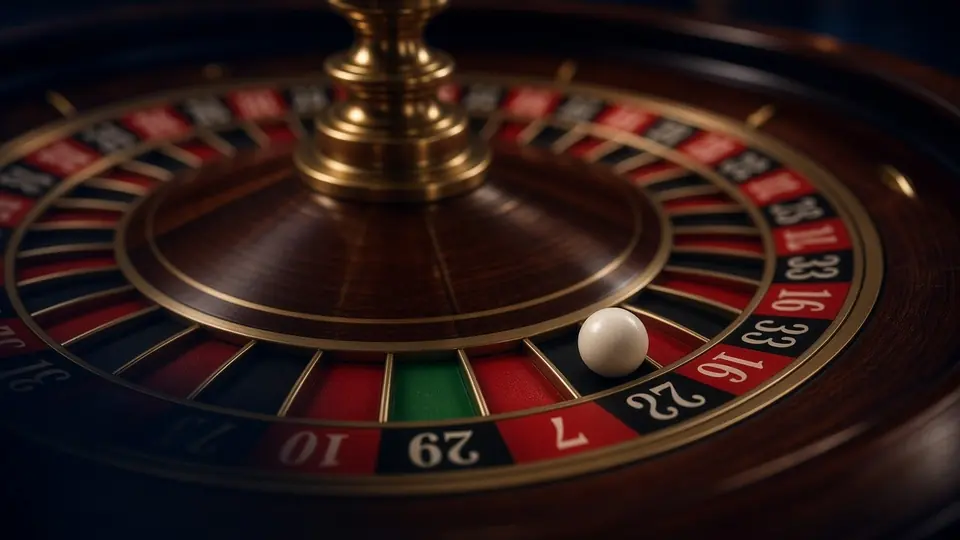
A European roulette wheel has 37 pockets, numbered 0 to 36. The zero is the only green pocket. Eighteen of the others are red and eighteen are black. An American wheel adds a second zero, which makes 38 pockets.
Every spin is independent and each pocket has the same chance, 1 in 37 on the European wheel.
What each bet pays
| Bet | Pockets covered | Payout | Chance of winning (37 pockets) |
|---|---|---|---|
| Single number | 1 | 35 to 1 | 2.70% |
| Red or black | 18 | 1 to 1 | 48.6% |
| Dozen | 12 | 2 to 1 | 32.4% |
| Column | 12 | 2 to 1 | 32.4% |
In every case a win pays one unit less than the fair price. For a single number the fair price would be 36 to 1, since there are 37 pockets with equal chances, but the table pays 35 to 1. That missing unit in every 37 is the edge: 1/37 = 2.70%.
For red or black, the player wins 18 times in 37 and loses 19 times in 37, so a unit bet returns on average (18 × 2 + 0) / 37 = 0.973 units. The edge is again 2.70%. Every bet on the wheel, from a single number to a dozen, has the same house edge. Choosing a "safer" bet reduces variance but not the cost per euro staked.
On the double-zero wheel the same logic gives 2/38 = 5.26%, almost double.
The doubling system
The best-known system is the Martingale: bet one unit on red, and if it loses, double the stake; when you finally win, you are one unit ahead. It seems to work because the chance of losing many times in a row is small. But it breaks down in two ways.
The numbers get large quickly. Starting at €5, six losses in a row cost 5 + 10 + 20 + 40 + 80 + 160 = €315, and the next bet would have to be €320. Eight losses in a row cost €1,275. The reward for surviving all of this is the same €5.
The losing run is not rare enough. On a single-zero wheel the chance of losing a single red or black bet is 19/37, about 51.4%. The chance of losing six in a row is (19/37)^6, about 1.8%, and of eight in a row about 0.48%. Those sound small, but a player who repeats the system hundreds of times meets them. Each time, the loss is far larger than the many small wins.
On top of this, tables have maximum bets, so there is a point where you can no longer double. The edge is untouched: a series of bets that each lose 2.70% on average also loses 2.70% on average in total. The system changes the pattern of wins and losses, with many small wins and a rare, large loss. It does not change the average.
Slot machines
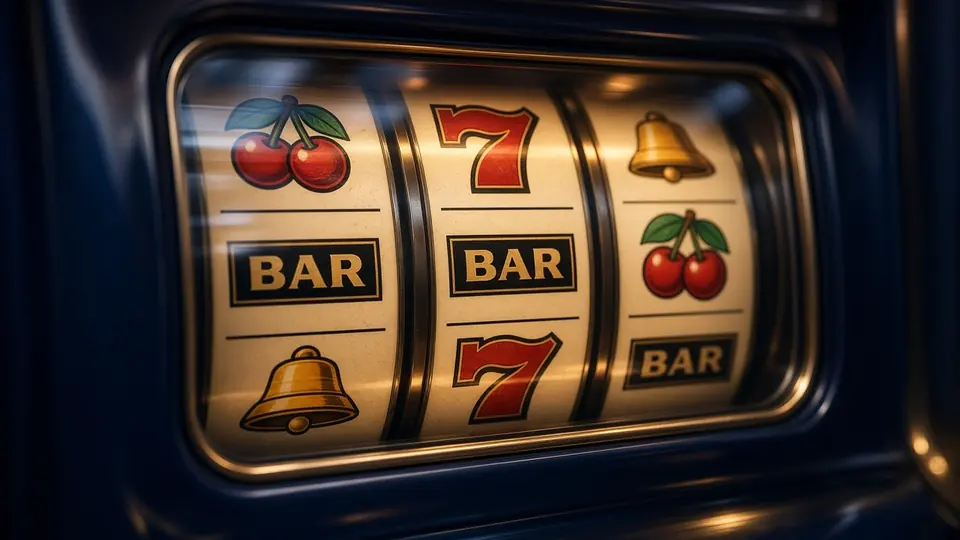
A slot machine looks very different, but the same ideas apply. Two figures describe it:
- Return to player (RTP): the long-run percentage of stakes that the machine pays back. A machine with an RTP of 95% keeps 5% on average.
- Volatility (variance): how the returns are spread. High volatility means rare, large wins; low volatility means frequent small ones.
The outcome of each spin is decided by software, not by what happened on the earlier spins. A machine is not "due" because it has not paid for a while, and a near miss on the screen is not a sign of a near win. The probability of the next outcome is the same either way.
What a slot does not show
Most of what a slot shows is animation. Winning combinations, feature sequences and sounds are presentation. The numbers that matter are the probability of winning and the RTP. In Finland, the Gambling Act requires licensed operators to make the probability of winning, the price of the game and an assessment of the risk of harm available to players (section 37). It also lets the Government set the share of stakes paid back by games under the exclusive licence (section 31) and deals separately with the placement of slot machines to minimise harm, especially to minors and vulnerable people (section 38). The Act also provides that online slot machine games count as a type of gambling that may be covered by maximum loss limits set by government decree (section 32).
Pace matters
Expected loss equals total stakes times the edge, so the speed of play matters as much as the RTP. A fast game with a 5% edge at 10 euros a minute costs 50 cents a minute on average; at 100 euros a minute it costs 5 euros. The Act's definition of an online slot game, in which the participation fee, the draw and the payment of winnings form a consecutive and integrated game event, describes this fast cycle (section 3).
Putting it together
- Every roulette bet has the same edge, so a "safe" bet is not cheaper.
- A system can reshape your wins and losses but cannot change the average.
- For slots, look for the published RTP and the information the operator has to provide, and remember that speed multiplies the cost.
- Use the limits in the self-exclusion guide before you start, not after.
Quick answers
Is a single-zero wheel better than a double-zero wheel?
Yes. The edge is 2.70% against 5.26%.
Can I win at roulette by using a system?
Systems cannot change the average. They change how wins and losses are distributed.
Does a slot machine get hot or cold?
Each spin is decided independently, so a machine does not warm up or cool down.
Sources
The numbers on this page are our own arithmetic from the stated rules. They describe long-run averages, not what will happen in any single session. Nothing here is a betting tip or an encouragement to gamble.