
Two sides of one number
Every gambling game pays back less than it takes in, on average. The share it keeps is the house edge. The share it returns is the return to player, usually shortened to RTP. They add to 100%.
- If the house edge is 5%, the RTP is 95%.
- If the RTP is 97.3%, the house edge is 2.7%.
These figures describe the long run: they are averages over very many bets. They do not say what will happen in your next ten minutes.
Expected loss: the one calculation to learn
The expected loss in a session is simple:
Expected loss = total amount staked × house edge
Total amount staked is the sum of every bet you place, not the money you bring. This matters because money is reused. If you start with €100 and win and re-bet again and again, you may stake €1,000 in total even though you never put more than €100 on the table.
Example
You play roulette on a European wheel with a house edge of 2.70% and place 200 bets of €5. Total staked is €1,000. Expected loss is 1,000 × 0.027 = €27. Over long sessions, the more you bet, the closer you get to losing about 2.7% of everything you stake.
Faster games therefore cost more per hour. A game with a small edge but many bets per minute can have a larger expected loss per hour than a game with a bigger edge and slow play.
Where the edge comes from
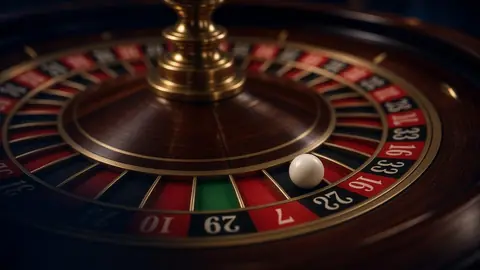
The edge comes from paying less than the true odds. A European roulette wheel has 37 pockets. A bet on a single number has a 1 in 37 chance of winning, so a fair payout would be 36 to 1 (35 profit plus the stake). The casino pays 35 to 1. That one unit is the edge: 1/37 = 2.70%. The same maths gives about 5.26% (2/38) on a wheel with a double zero, which has 38 pockets. See roulette and slots.
In betting, the edge is the margin built into the odds, as shown in the odds guide. In lotteries, it is the share of the money collected that is not paid out as winnings.
Why people still win in the short run
If the edge is against you, why do people win? Because the edge is an average over many bets, and single results are random.
Take 100 bets of €10 on a single roulette number. You win only if the number comes up at least 3 times (each win pays €350 against the €10 stakes): the chance is about 51%. So after 100 bets you are roughly as likely as not to be ahead. After 1,000 bets, you need at least 28 wins: the chance falls to about 45%. The chance of being ahead shrinks slowly, and the expected loss still grows with every bet, because the few huge wins are balanced by many small losses.
That is the trap. A winning evening is real, not an illusion, but it says very little about whether the game is worth playing. The more you play, the more the result moves toward the average.
Variance: why the same RTP can feel so different
Two games can have the same RTP and feel entirely different. A high-variance game pays back through rare large wins; a low-variance game pays small amounts often. A single-number roulette bet is high-variance, a red-or-black bet is low-variance, but the expected loss per euro staked is the same, 2.70%. Variance changes the shape of the ride, not the destination.
Betting systems do not change the edge
Systems such as doubling after each loss, betting patterns, "cold numbers" and "hot machines" do not change the edge. Each bet is a separate event with its own negative expectation, and a combination of negative-expectation bets is still a negative-expectation bet. A system can change when you win and when you lose, but not how much you lose on average. The roulette guide shows what happens to doubling.
What the law requires licensed operators to say
Under the Gambling Act, licensed operators must make the probability of winning, the price of the game and a harm-risk assessment available to players (section 37). For games run under an exclusive licence, the Government sets by decree the proportion of the participation fees that is paid to players as winnings (section 31). If you want the real figure for a game, look for the published probability or RTP, not for the advertising.
A practical way to use this
- Pick the amount you are happy to lose entirely.
- Estimate how much you will stake in total, remembering that re-betting multiplies it.
- Multiply by the house edge to see the expected cost.
- Ask whether that cost is worth the entertainment, as you would for a cinema ticket.
If the answer is yes, set a limit and keep to it (see limits). If you find that the answer keeps changing, or that you are betting more to recover losses, read the warning signs.
Quick answers
What is a good house edge?
For the player, lower is always better, but it is never zero or negative in licensed games. The edge is the price of playing.
Is RTP a promise?
No. It is a long-run average. In one session the result can be far above or far below it.
Does a bigger bankroll beat the house edge?
No. It lets you play longer, so you stake more in total and the expected loss grows.
Sources
The numbers on this page are our own arithmetic from the stated rules. They describe long-run averages, not what will happen in any single session. Nothing here is a betting tip or an encouragement to gamble.